
A training company sends out the same document forty times a year: a proposal for a course. Two people write them, and both are good at it. Both get the first draft out of an AI assistant in a couple of minutes instead of an hour, which is why the company started doing it that way.
Then a client who has received proposals from both of them asks, politely, why the second one looks like it came from somewhere else. The sections are in a different order. One names the trainer and gives their background; the other does not mention who is teaching. One quotes the fee as a range, which the company stopped doing a year ago. Nothing in either document is wrong, exactly. They are simply not the same company's proposal.
Neither person was careless. They each typed their own instructions into their own chat window, from memory, on different days, and the assistant did precisely what it was asked. The difficulty is that it was asked two different things.
This article is about the shift away from that: the same work before and after the instructions stop living inside people's heads. It is a practical change, it has become much easier in the last few weeks, and it is one of the few things you can do about AI output that does not involve buying anything new.
The thing that varies is not the AI
It is tempting to read those two proposals and conclude that the assistant is unreliable. It is more useful to read them as what they are: two different briefs, which produced two different documents.
An assistant is doing the one thing it is built to do, which is follow the brief in front of it. If that brief is retyped from memory every time, by a person recalling what the company currently does, then the thing varying between drafts is not the model. It is the brief.
That is worth getting straight, because it tells you where the fix goes. Not in choosing a cleverer tool, and not in sending people on a prompt-writing course. The fix is to write the brief down once, somewhere every assistant in the business reads it.
Before: the instruction is retyped from memory
Here is what the before state actually looks like, in a company where several people use an assistant for the same job.
Each person has their own wording for the instruction, and each one's wording drifts as they get better at it. The company's real decisions — we no longer quote a range, we always name the trainer, we never promise a start date in a first draft — are remembered by some people and not by others, because nobody ever wrote them next to the work. When one of those decisions changes, nothing else changes, since there is nothing to edit. And the only record of the best version of the instruction is sitting in one person's chat history, which nobody else can open.
It works, in the sense that documents go out and the work gets done faster than it used to. It just does not hold together, and the first person to notice is usually a client who has seen two of them.
After: the instruction is something you can open
The after state is small and unglamorous. The instruction becomes a thing you can open.
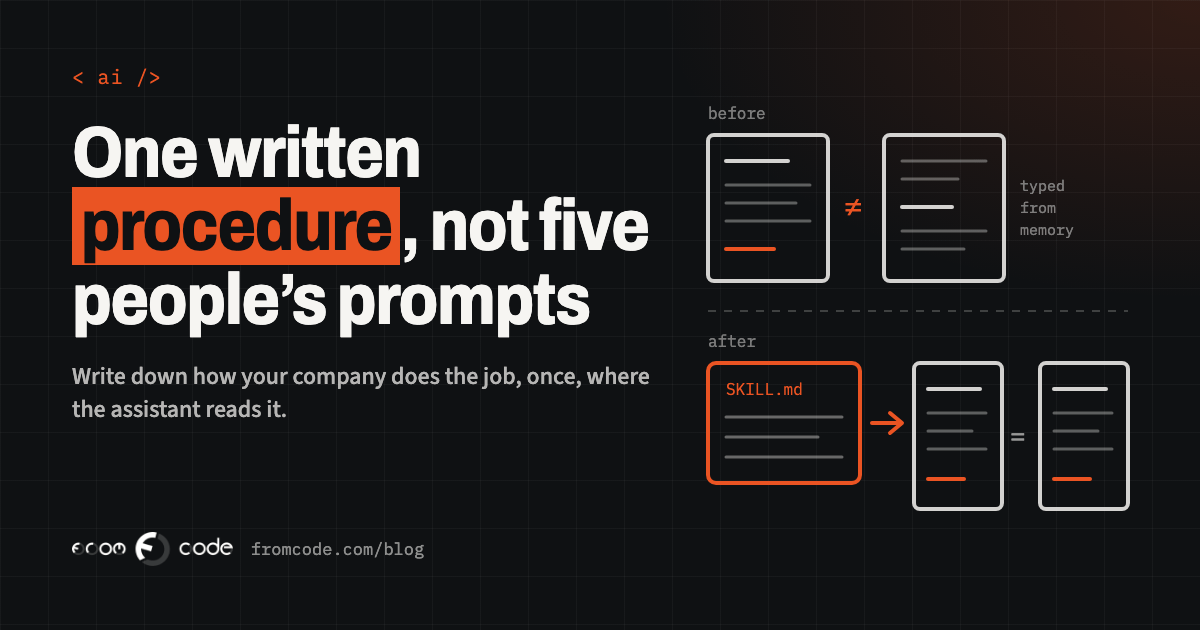
It has a name, so people refer to it by that name rather than describing it. It holds the company's rules for that document, the template the document should follow, and the reference files the job needs — the fee list, the trainer biographies, last year's best example. Everyone's assistant starts from the same one. When a rule changes you edit it in one place, and every draft after that follows the new rule without anyone being told.
This is not a theory. It is the feature the large providers have just finished building, and they have converged on the same name for it: skills. Google began rolling skills out inside Workspace on 9 November 2026 for domains on the rapid release track, and from 30 November 2026 for domains on the scheduled track, describing them as reusable, custom instructions that guide Gemini to apply your team's rules, templates, and reference files. They are included from Business Starter upwards, so this is not an enterprise-only capability.
What a skill actually is
A skill is not a cleverer prompt. In Anthropic's version, announced on 16 October 2025 and published as an open standard in December that year, a skill is literally a folder: a Markdown file called SKILL.md holding the instructions in plain writing, plus whatever other files the job needs.
That is the part worth noticing. A folder with a text file in it is something a business can read, review, keep in a shared drive, give to a new member of staff and change on a Tuesday afternoon. It is a written procedure that happens to be machine-readable, rather than a configuration setting buried in somebody's account.
Before: one person is the system
In most small companies one person turns out to be unusually good at getting useful output from an assistant. They become the informal system. Colleagues send them things to run, or ask them what to type, and the whole arrangement works well right up to the week they are on leave.
This is the same concentration problem businesses already know from spreadsheets and from the one developer who understands the old site. The knowledge is real, it is valuable, and it exists in exactly one head.
After, that person is still the most capable — but what they know is now written in the procedure, so their skill goes into improving it rather than into being available. That is a better use of them, and it survives their holiday.
Before: nobody can say which version is current
The other thing that disappears quietly is the question of which version is right.
Before, you cannot answer it. There are four wordings in four chat histories and no way to tell which one reflects what the company decided in March. After, the procedure has an owner and a date on it, the way a price list does. Somebody is responsible for it being correct, and when it is wrong there is a specific thing to correct.
Administrators get the matching controls. In Workspace, skills can be switched off for a whole domain, an organisational unit or a single group, and their use can be audited. That is the difference between a capability a business has decided to use and one that arrived through whoever signed up first.
What to write down first
If you are going to write down one procedure this month, choose the job that goes out of the building most often and matters most when it is inconsistent. Then put five things in it:
- The output. What the finished thing looks like: its sections, in order, and roughly how long each one is.
- The decisions that are easy to get wrong. What you no longer offer. What must always be named. What must never be promised in a first draft. These are the lines that caused the problem in the first place.
- Your words. The terms you use for your own services, and the ones you avoid. This is most of what makes a document sound like your company rather than like anyone's.
- The reference material. Where the current fees, biographies, descriptions and examples live, so the assistant uses those rather than inventing plausible ones.
- Who checks it. The procedure should end by saying who reads the draft before it goes out, because this does not remove that step.
That is an afternoon's work for the first one, and considerably less for the second, because by then you know what shape it takes.
Before: a new starter learns by watching
A new member of staff used to learn this job by watching, asking and getting things slightly wrong for a month. Some of what they picked up was the company's actual practice and some of it was one colleague's habit, and nobody could tell which was which, including them.
After, their first day includes reading the procedure. They will still need judgement, and they will still send their first few drafts to somebody. But they start from what the company decided, rather than from a reconstruction of it. For a business that is growing, this is the part that compounds.
What this does not fix
It would be dishonest to present this as more than it is, so here is what it does not do.
It does not check facts. A procedure makes the output consistent, which is a different property from correct. If the fee list it points at is out of date, every draft will be confidently out of date in exactly the same way, and that is arguably worse than the inconsistent version, because it looks deliberate. Someone still reads the draft.
It is also not finished software. Google's own notes say skills in Workspace are not yet available in Google Sheets or Google Meet and currently support English only, and that skills created in Workspace do not automatically sync with skills in the Gemini app. If your work is in spreadsheets or in another language, this particular implementation is not your answer yet.
And it is a separate question from whether the material should be going into the tool at all. Writing a procedure tells your staff how to do the job; it does not decide which information is allowed to leave the building. That decision comes first, and it is the subject of a different conversation.
If somebody built you a Gem
One practical warning, because it has a date attached and dates are the sort of thing that surprise a business on a Monday.
If somebody in your company built a custom assistant in Google's Gemini app — these were called Gems — that arrangement is being replaced by skills. On personal accounts, Gems became read-only on 17 November 2026 and are removed on 17 December 2026; work and school accounts move later, in March 2027 for business and enterprise. Existing Gems are converted automatically, and they can also be recreated by hand.
The useful action is not technical. It is to find out whether anything the business now relies on was built that way, by whom, and in whose account. That question is worth asking about every AI tool in use, not only this one: a procedure the company depends on should not be living in an individual's personal login.
What I would do
If I were introducing this into a company of ten people, I would not start with the tools. I would start by picking the one document that goes out most often and asking the two or three people who write it to describe, out loud, what they currently type. The gaps in that conversation are the procedure.
Then I would write it as plain prose — not a prompt, not a template with brackets, just the instruction as you would give it to a competent new colleague — and put it where the business keeps its other written procedures. Only after that would I load it into whichever assistant the company already pays for.
The order matters because the written version is the valuable thing. If you switch assistants next year, or the provider renames the feature again, the procedure is still correct and still yours. If you had only ever configured it inside one product, you would be starting over.
The change here is smaller than the amount of noise around AI suggests. Nobody is automating the proposal. A person still writes it, sends it and answers the client's questions about it.
What changes is that the company's own way of doing the job stops being folklore and becomes a document — one that the assistant reads as reliably as the new starter does. That is the whole of it, and it is why the providers have all shipped the same feature within a few weeks of each other. The constraint was never the model. It was that nobody had written down what the business actually wanted.
Which job in your business would benefit most from being written down once?
Discuss your projectIf you want help turning the way your company actually works into something your systems and your staff can both follow, tell me about it.