
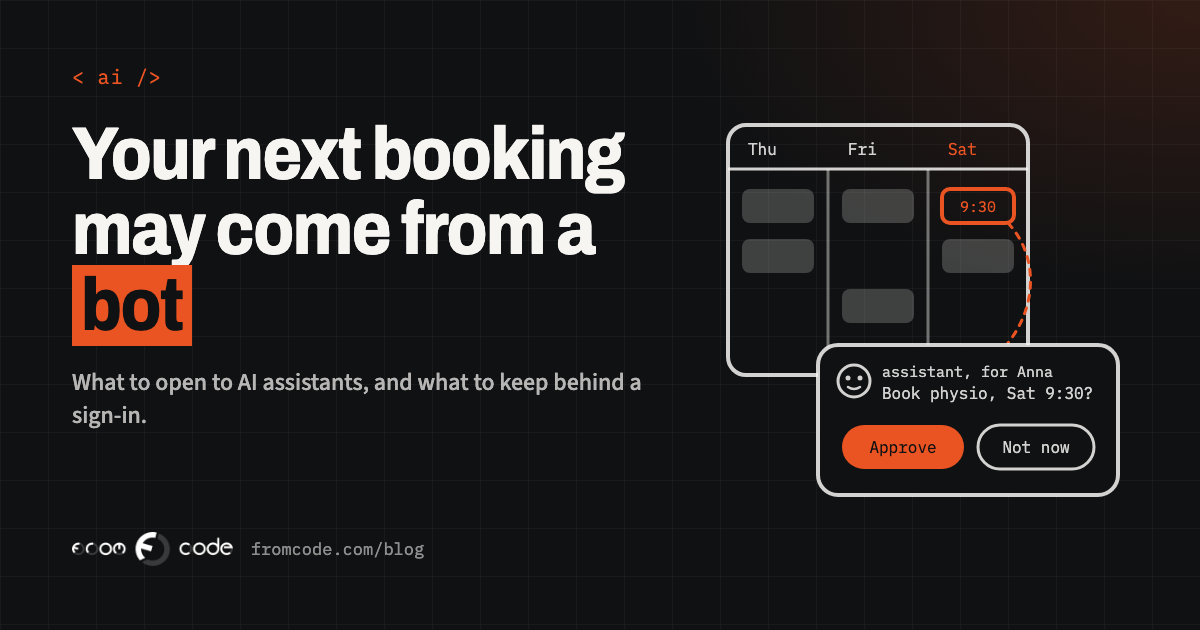
Picture a physiotherapy clinic on a Monday morning. A patient has asked the AI assistant on their phone to "find me a physio near work, Saturday morning, under an hour away, and book it". The assistant goes looking. One clinic has its prices, its treatments and its free slots on pages the assistant can read and a booking system it can use. Another has a PDF price list, a phone number and a contact form that says "we will get back to you". You can guess which clinic gets the booking, and the second one never even learns it was considered.
That is no longer a thought experiment. The large AI companies are building assistants that act for people, and in October 2026 a group of them started agreeing on how those assistants should deal with businesses. A lot of what is being said about it is either hype or alarm. This article sorts the claims I hear from business owners into what is true and what is not, and ends with what I would actually do about it this year if it were my business.
What actually happened
On 6 October 2026, Sierra, the AI customer-service company, announced the Personal Agent Protocol: an open standard it is developing with Meta and a group of industry partners for how a person's AI assistant should deal with a company. A first public draft, nicknamed "Poppy", is published openly under an open-source licence, and Sierra says a first formal version, v0.1, is planned for later in October, followed by workshops and a reference implementation.
In plain words, it describes three things. How an assistant finds out what your business offers and how to talk to it. How it can look around as a guest, asking about availability or a policy, without signing in. And how a customer lets their assistant act on their account: they sign in on your own page and choose whether the assistant may only look, or also make changes. Payments are not part of it yet; the draft mentions them as a possible extension later.
It is a draft. Names, details and the exact file format may change before anything is final, and I would not build anything that depends on the details today. What matters for a business owner is the direction, and that is clear enough.
Myth 1: "This is years away, and only for big companies"
**The myth:** assistants that book things on their own are a story for the 2030s, and when they arrive they will only work with airlines, banks and the very largest companies.
**What is true:** the companies writing this standard make assistants and run customer service for very large businesses, so of course they start there. But the protocol is open, anyone may implement it, and the thing it describes is ordinary: look up a service, check availability, make a booking, change it. Those are exactly the things a clinic, a driving school, a beauty salon or an accountant's office does all day.
The timing matters too. Agreements like this one are how a new habit becomes normal. Once the big assistants speak one language to businesses, customers will simply expect to say "book it" and have it done, the way they now expect a site to work on their phone.
Myth 2: "I need to build my own AI to take part"
**The myth:** to be found by AI assistants, a business needs an AI of its own, a chatbot on the site, or an expensive new platform.
**What is true:** Sierra's announcement names three ways an assistant can deal with a company, and the business chooses: through its **website**, through its **APIs** (the technical doors other software uses, built with established standards such as MCP and OpenAPI), or through the company's **own agent**, if it has one. The first two need no AI on your side at all.
What they do need is a business whose information and booking actually work without a person in the middle. If your free slots live in someone's head or in a paper diary, no assistant can book them, and no protocol fixes that. If they live in a proper booking system with clear rules, you are most of the way there already.
Myth 3: "An assistant gets the keys to the whole account"
**The myth:** if a customer lets an AI assistant act for them, the assistant can do anything on their account: see everything, cancel everything, pay for anything.
**What is true:** the draft is built on OAuth, the same sign-in method behind "Sign in with Google". The customer signs in on **your** page, not inside the assistant, and chooses what the assistant may do: only view, or also make changes. The business decides what an assistant is allowed to do at all. In the draft's own example, some actions, such as making a booking, happen only with the person's approval. Access lasts until the customer or the business withdraws it.
That is a sensible design, and it mirrors what I recommend for any system that lets software act for a person: narrow permissions, granted by the person, revocable at any moment, and the dangerous actions confirmed by a human.
Myth 4: "Nobody will know whether a person or a bot booked"
**The myth:** once assistants start booking, a business cannot tell who did what, and nobody is responsible when a booking goes wrong.
**What is true:** the whole point of a protocol like this is to make an assistant identify itself and act inside a session the customer opened. That is better than today, where software that fills in web forms usually just pretends to be a person.
But a standard only helps if your own system enforces your own rules. If your cancellation policy, your deposit, your limit of one new-patient appointment per person, or your rule that a 90-minute treatment cannot start at 17:30 live only in the wording of a web page, an assistant will not read them the way a careful person does. Rules have to be checked by the booking system itself, every time, whoever or whatever is asking. That was always true; assistants just make it urgent.
Myth 5: "The safest thing is to block all bots"
**The myth:** the safe choice is to block every bot and wait until the dust settles.
**What is true:** you can, and for some things you should. But blocking everything has a cost that does not show up anywhere: the customer whose assistant could not read your prices, your services or your opening hours is simply booked somewhere else, and you never hear about it.
The sensible middle is to separate looking from doing. Information you would happily print on a leaflet (services, prices, opening hours, location, which slots are free) should be easy for any assistant to read. Anything that changes something (a booking, a cancellation, a change to someone's details) sits behind the customer's own sign-in, under your rules, with confirmation where it matters.
What this does not change
It is easy to read news like this and conclude that everything must be rebuilt. Very little actually changes:
- Your customers still choose on trust, price, location and how they were treated last time. An assistant only shortlists; people still decide where they are happy to go.
- Your booking rules are still yours. No standard tells you how far ahead people may book or what a late cancellation costs.
- Privacy law still applies. An assistant acting for a customer is still processing that customer's personal data on your systems, and the usual obligations about what you collect and keep do not go away.
- A slow, confusing booking flow is still a slow, confusing booking flow. Assistants will give up on it too, just faster than people do.
Where the existing standards fit
The protocol does not appear from nowhere. It leans on standards that already exist. One of them is MCP, the Model Context Protocol, which I wrote about in an earlier article on letting an assistant work on your own system. In December 2025 Anthropic handed MCP over to the Agentic AI Foundation, a new body under the Linux Foundation co-founded with OpenAI and Block, so that no single company controls it.
That matters for a small business for one reason: work done to give your system clean, well-described doors for other software is not wasted when the fashionable standard changes. A booking system with a proper API can be connected to whichever assistant protocol wins. One that only works through its web pages can only be used by an assistant that pretends to be a person, which is the fragile, untrustworthy route everyone is trying to move away from.
Keep the public facts current and machine-readable: services, prices, opening hours, location. Make free slots visible without a phone call. Write your booking rules into the booking system, not just onto the page. Make sure every booking, from any source, is checked against the same rules. Decide now which actions always need a person's confirmation.
Being ready without rebuilding anything
Most of the work that makes a business ready for assistants is the same work that makes it pleasant for people, which is why it is worth doing now rather than when the standard is final.
Start with what anyone can see. Are your services and prices on real pages, in text, rather than in images or PDFs? Are your opening hours the same on your site, your Google listing and your door? Contradictions confuse assistants exactly as they confuse people, and an assistant will not phone you to ask which one is right.
Then look at booking. Can someone see a free slot and take it without waiting for a reply? If the honest answer is "we confirm every request by phone", ask why. Sometimes there is a good reason, such as a first consultation that needs a conversation first. Often it is a habit from before the booking system existed.
Finally, look underneath. Does the booking system check its rules itself, or does it trust the page in front of it? Can two people, or two assistants, take the same slot at the same moment? Is there a record of who made each booking, and from where? These are the questions that decide whether assistant bookings become a convenience or a source of mess.
What I would do if it were my clinic
If I were running that clinic from the opening, I would not touch the protocol yet. It is a draft, and the reference implementation is not out. I would spend the next few months on the ground it will stand on.
I would make sure every service had its own clear page with its length, price and who provides it. I would put real availability online and let returning patients book and move their own appointments. I would move the rules out of the receptionist's memory and into the booking system: new patients get a longer first slot, some treatments need a referral, cancellations inside 24 hours are flagged. And I would make sure the booking system had a proper API, so that when the standard settles, connecting it is a small, contained job instead of a rebuild.
None of that is speculative. It pays off this month in fewer phone calls and fewer double bookings, and it happens to be exactly what an assistant needs later.
What to watch next
A few things are worth keeping an eye on over the coming months, without acting on them yet. Whether the v0.1 version arrives as planned, and how much it differs from the draft. Which assistants actually start using it with real businesses, rather than announcing support. Whether booking and appointment systems you already rent add support themselves, in which case you may get it without doing anything. And whether payments are added, because that is where the hardest questions about who is responsible will be decided.
If someone offers to make your business "AI-agent ready" for a fee before any of this is settled, ask them which version of which standard they mean, and what exactly will be different the day after they finish.
The short version
Assistants that act for customers are coming the way online booking came: slowly, then everywhere. The businesses that do well will not be the ones with a chatbot on the home page. They will be the ones whose information is clear, whose availability is real, and whose rules are enforced by their own systems, so that a booking made by a person and a booking made by an assistant are held to exactly the same standard.
That is unglamorous work, and it is the work I enjoy most: making the system underneath honest, so that whatever arrives at the front door, the business stays in charge of what happens next.
Could an AI assistant book with your business today?
Discuss your projectTell me how bookings reach you now, and I will tell you what stands in the way.